This is probably the single most infuriating topic of the whole pandemic for me: risk.
No, not people taking risks. Rather, it’s about people — and especially leaders — being unable to conduct a proper risk analysis. The implications can be very dire, as we have seen. In fact, a hasty, or incomplete, or ridiculously-shallow-what-the-hell-is-wrong-with-you-for-even-thinking-this-was-an-acceptable-level-of-analysis analysis can be deadly.
Now that vaccination is widespread in both Canada and France (among other places, of course), we can relax a little. Not let our guard down, or forget there’s a virus out there, or anything like that. But certainly relax. I don’t know about most of you, but when I got my jabs, it felt like a huge weight had been lifted from my shoulders. This vaccine, and more accurately vaccines in general, are one of humanity’s greatest achievements.
Yet I’m still seeing vaccine hesitancy. I met people not too long ago who’s vaccine-hesitant, and just didn’t want to talk about it. It scared them, in fact. Between the usual fears peddled by the anti-vaxxers, like this vaccine was prepared too quickly (it wasn’t) and proper risk studies weren’t undertaken (they were), they also point to stories about people still getting the virus after being vaccinated. So between those stories and the scare mongering, they weren’t getting the vaccine, at least not yet.
This is where your actions could play a big role. It’s easy to retweet these anecdotes, and we should pay attention. But presenting them out of context can also backfire, and that’s not something we really can afford right now.
In a previous post from what seems like an eternity ago but was, in fact, just before Christmas, I discussed the concept of acceptable risk. That is, knowing that risk will almost never be zero, what actions are you comfortable with before things get too risky? The answer, of course, depends on your personal risk tolerance. (Or, say, 7. Anything riskier than 7 is too risky. But the first version is probably more accurate, because 7 is such a vague number as to be meaningless.)
Along with risk tolerance, there’s risk mitigation. What can you do to make these situations safer? Then, do those things. The risk drops further. This does not mean your risk is zero; but it does mean that your risk is much lower than people engaging in very high-risk activities.
But one thing was missing from that post– thinking through the consequences. Not just of doing a particular action, but of not doing an action. Or taking the opposite action. This is especially true of unintended consequences. Your most well-meaning action could have detrimental effects you didn’t consider.
You’ve seen the big scary headlines about the risks from the vaccines, from blood clots to heart inflammation. We’re well aware by now that the odds of those side effects turned out to be minimal. But the damage had been done. These fears, which turned out to be overblown, did their damage in vaccine confidence, which has been covered extensively elsewhere and I don’t need to get into here.
What really struck me about these people, though, was the number of people who would say things like “What if it was your child who died from the vaccine side effect?” or “Even one death from the vaccine is too many!” or things of the sort. These people seem to think there were two options: Don’t get the vaccine and face no risk from the vaccine, and get the vaccine and face risk from the vaccine.
They’re forgetting a key element in this: The virus itself. The better analysis would be: don’t get the vaccine, face no risk from the vaccine, and face a far greater risk of getting the virus than with the vaccine; or, get the vaccine, face a minuscule risk from the vaccine, and face a far smaller risk of getting the virus than without the vaccine. The overall amount of risk is definitely greater when you don’t get the vaccine. But at least you’re not risking any vaccine side effects, I guess.
Another aspect you might not have thought about: Don’t get the vaccine, and continue with this pattern of lockdown-reopening-lockdown again. The mental and physical health issues with stay-at-home orders are documented elsewhere, and it’s not necessary to go into detail here. What is important is that this is yet another risk factor that directly relates to the vaccine, one that far too many people aren’t taking into account before announcing they won’t put this vaccine poison in them.
There are certainly other factors that will vary with the vaccine uptake, but the point is this: It’s never a binary choice with these things. You can’t even beware unintended consequences if you can’t be bothered to even think that could be unintended consequences.
Then there’s the blatant fear mongering from the media that certainly disregard consequences. Toward late July and early August, a scary new CDC “leaked” report that led to some scary headlines: The Delta variant is perhaps as contagious as chicken pox; unvaccinated people are potentially huge vectors of spreading the virus; and lots of vaccinated people are getting the infection. In fact, here’s a terrifying NBC headline:
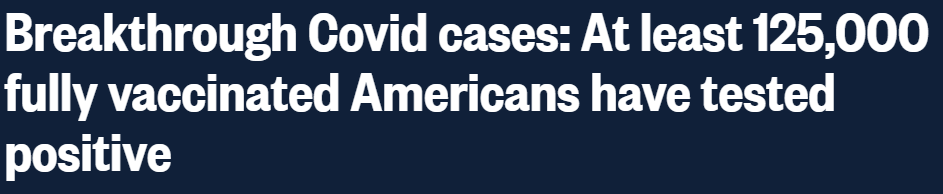
Context, though, is everything. While that number is indeed high, what is its share of the total population? The total may surprise you:
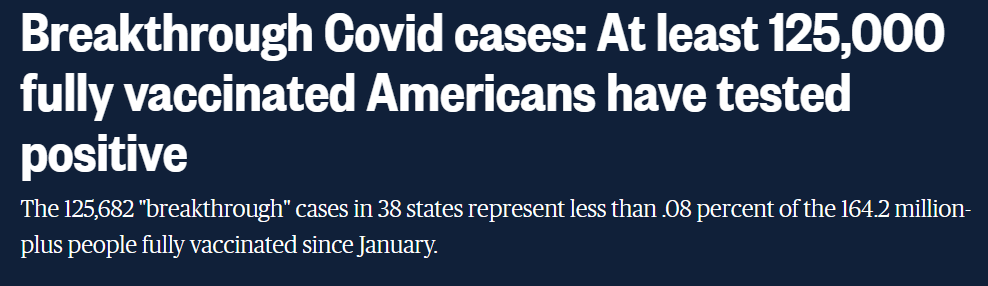
Less than 0.08%. Overall, that sounds like a wonderfully effective vaccine. Factor in those who didn’t require hospitalization, and the benefits of the vaccine become even clearer. But to hear it over that weekend, it was like vaccines are useless and we’re back to square 1. When we’re not. In fact, people choosing to get the vaccine led to much, much, much lower infections than might otherwise be expected (or seen in places with low vaccine uptake, either by lack of supply or — more disturbingly — vaccine denial [I’m looking at you, U.S. Deep South!].)
So why bother getting the vaccine? The nuanced story tells you why. The big scary headlines lots of people are sharing will dissuade you.
There’s also the scary study from Provincetown, Mass., that showed lots of vaccinated people were testing positive. But, as with any studies, there are any limitations — and you can read most of those for yourself in the study, although not necessarily in news stories on the matter.
The Columbia Journalism Review did a great job explaining some of the pitfalls in covering that CDC “leak”, citing Dr. James Hamblin, who said:
I hesitate to even call this a leak because that implies a trove of classified secrets; it’s more of a document that’s not written for an audience other than public-health officials, nor finalized enough to warrant publication.
Mr. Hamblin also brought up a great point that seemed to be overlooked by the reporting on the slide deck:
In any case, the first and key point made in the powerpoint is that the vaccines are still extremely effective: Getting vaccinated reduces your risk of hospitalization or death 25-fold.
In most place and in most times, this would be the good news that makes everyone’s news feeds. Alas, these are not most places nor most times.
Context matters. The whole study matters. The caveats matter. The analysis matters.
Sadly, what else matters is the out-of-context sharing many people are doing, which are having a slowly damaging effect on the trust in vaccines. The next time you see scary headlines, stop and look behind the story. See what the study really says. Do the math — does this seem right? And even wait a few days before sharing, because in that time, someone like Dr. Hamblin might come out with a note that shows, while concerning in many respects, the news is actually encouraging. Right now, we should be leading off with the encouraging, because we’ve had more than a year of negativity. This is not to say we should ignore the negativity — far from it, in fact — but is it too much to ask that we highlight the good with the bad?
I guess if you’re NBC News, it is. But the rest of us don’t have to resort to that click bait. Your decision to hold off on spreading a scary anecdote just might give others time to respond to anecdotes with data, or at least counter-anecdotes that might cancel out the first anecdotes. And anecdote meeting counter-anecdote does leave us at square one.
 Canuckistan Takes Paris!