Let’s talk about risk, baby

This is probably the single most infuriating topic of the whole pandemic for me: risk.

No, not people taking risks. Rather, it’s about people — and especially leaders — being unable to conduct a proper risk analysis. The implications can be very dire, as we have seen. In fact, a hasty, or incomplete, or ridiculously-shallow-what-the-hell-is-wrong-with-you-for-even-thinking-this-was-an-acceptable-level-of-analysis analysis can be deadly.

Now that vaccination is widespread in both Canada and France (among other places, of course), we can relax a little. Not let our guard down, or forget there’s a virus out there, or anything like that. But certainly relax. I don’t know about most of you, but when I got my jabs, it felt like a huge weight had been lifted from my shoulders. This vaccine, and more accurately vaccines in general, are one of humanity’s greatest achievements.

Yet I’m still seeing vaccine hesitancy. I met people not too long ago who’s vaccine-hesitant, and just didn’t want to talk about it. It scared them, in fact. Between the usual fears peddled by the anti-vaxxers, like this vaccine was prepared too quickly (it wasn’t) and proper risk studies weren’t undertaken (they were), they also point to stories about people still getting the virus after being vaccinated. So between those stories and the scare mongering, they weren’t getting the vaccine, at least not yet.

This is where your actions could play a big role. It’s easy to retweet these anecdotes, and we should pay attention. But presenting them out of context can also backfire, and that’s not something we really can afford right now.

In a previous post from what seems like an eternity ago but was, in fact, just before Christmas, I discussed the concept of acceptable risk. That is, knowing that risk will almost never be zero, what actions are you comfortable with before things get too risky? The answer, of course, depends on your personal risk tolerance. (Or, say, 7. Anything riskier than 7 is too risky. But the first version is probably more accurate, because 7 is such a vague number as to be meaningless.)

Along with risk tolerance, there’s risk mitigation. What can you do to make these situations safer? Then, do those things. The risk drops further. This does not mean your risk is zero; but it does mean that your risk is much lower than people engaging in very high-risk activities.

But one thing was missing from that post– thinking through the consequences. Not just of doing a particular action, but of not doing an action. Or taking the opposite action. This is especially true of unintended consequences. Your most well-meaning action could have detrimental effects you didn’t consider.

You’ve seen the big scary headlines about the risks from the vaccines, from blood clots to heart inflammation. We’re well aware by now that the odds of those side effects turned out to be minimal. But the damage had been done. These fears, which turned out to be overblown, did their damage in vaccine confidence, which has been covered extensively elsewhere and I don’t need to get into here.

What really struck me about these people, though, was the number of people who would say things like “What if it was your child who died from the vaccine side effect?” or “Even one death from the vaccine is too many!” or things of the sort. These people seem to think there were two options: Don’t get the vaccine and face no risk from the vaccine, and get the vaccine and face risk from the vaccine.

They’re forgetting a key element in this: The virus itself. The better analysis would be: don’t get the vaccine, face no risk from the vaccine, and face a far greater risk of getting the virus than with the vaccine; or, get the vaccine, face a minuscule risk from the vaccine, and face a far smaller risk of getting the virus than without the vaccine. The overall amount of risk is definitely greater when you don’t get the vaccine. But at least you’re not risking any vaccine side effects, I guess.

Another aspect you might not have thought about: Don’t get the vaccine, and continue with this pattern of lockdown-reopening-lockdown again. The mental and physical health issues with stay-at-home orders are documented elsewhere, and it’s not necessary to go into detail here. What is important is that this is yet another risk factor that directly relates to the vaccine, one that far too many people aren’t taking into account before announcing they won’t put this vaccine poison in them.

There are certainly other factors that will vary with the vaccine uptake, but the point is this: It’s never a binary choice with these things. You can’t even beware unintended consequences if you can’t be bothered to even think that could be unintended consequences.

Then there’s the blatant fear mongering from the media that certainly disregard consequences. Toward late July and early August, a scary new CDC “leaked” report that led to some scary headlines: The Delta variant is perhaps as contagious as chicken pox; unvaccinated people are potentially huge vectors of spreading the virus; and lots of vaccinated people are getting the infection. In fact, here’s a terrifying NBC headline:
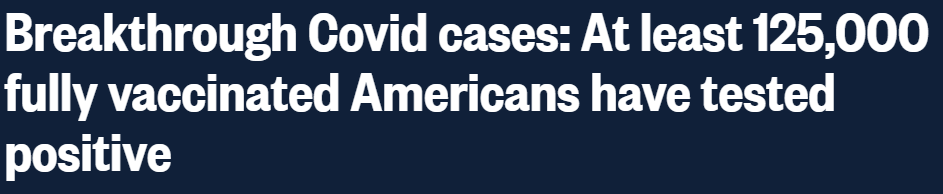
We’re all screwed, aren’t we?

Context, though, is everything. While that number is indeed high, what is its share of the total population? The total may surprise you:
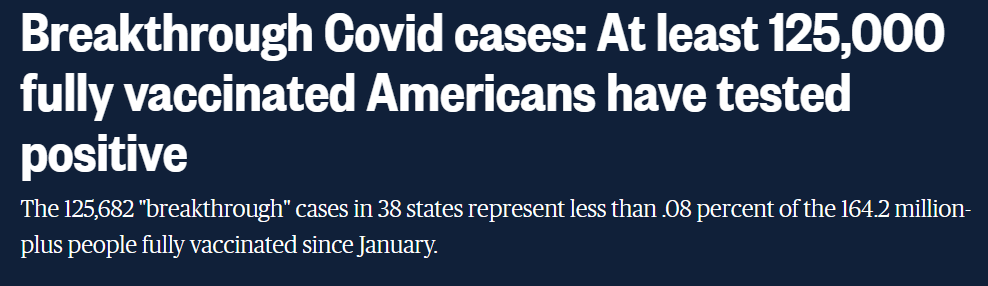
Well, maybe not all of us are screwed …

Less than 0.08%. Overall, that sounds like a wonderfully effective vaccine. Factor in those who didn’t require hospitalization, and the benefits of the vaccine become even clearer. But to hear it over that weekend, it was like vaccines are useless and we’re back to square 1. When we’re not. In fact, people choosing to get the vaccine led to much, much, much lower infections than might otherwise be expected (or seen in places with low vaccine uptake, either by lack of supply or — more disturbingly — vaccine denial [I’m looking at you, U.S. Deep South!].)

So why bother getting the vaccine? The nuanced story tells you why. The big scary headlines lots of people are sharing will dissuade you.

There’s also the scary study from Provincetown, Mass., that showed lots of vaccinated people were testing positive. But, as with any studies, there are any limitations — and you can read most of those for yourself in the study, although not necessarily in news stories on the matter.

The Columbia Journalism Review did a great job explaining some of the pitfalls in covering that CDC “leak”, citing Dr. James Hamblin, who said:

I hesitate to even call this a leak because that implies a trove of classified secrets; it’s more of a document that’s not written for an audience other than public-health officials, nor finalized enough to warrant publication.

Mr. Hamblin also brought up a great point that seemed to be overlooked by the reporting on the slide deck:

In any case, the first and key point made in the powerpoint is that the vaccines are still extremely effective: Getting vaccinated reduces your risk of hospitalization or death 25-fold.

In most place and in most times, this would be the good news that makes everyone’s news feeds. Alas, these are not most places nor most times.

Context matters. The whole study matters. The caveats matter. The analysis matters.

Sadly, what else matters is the out-of-context sharing many people are doing, which are having a slowly damaging effect on the trust in vaccines. The next time you see scary headlines, stop and look behind the story. See what the study really says. Do the math — does this seem right? And even wait a few days before sharing, because in that time, someone like Dr. Hamblin might come out with a note that shows, while concerning in many respects, the news is actually encouraging. Right now, we should be leading off with the encouraging, because we’ve had more than a year of negativity. This is not to say we should ignore the negativity — far from it, in fact — but is it too much to ask that we highlight the good with the bad?

I guess if you’re NBC News, it is. But the rest of us don’t have to resort to that click bait. Your decision to hold off on spreading a scary anecdote just might give others time to respond to anecdotes with data, or at least counter-anecdotes that might cancel out the first anecdotes. And anecdote meeting counter-anecdote does leave us at square one.


Science Gossip, and The Post-No-Study Challenge

In brief: Unless you understand a study, and believe it to of sufficient quality, do not post the study or news stories about it on your social media. Let’s all do our part to stamp out science gossip, the misinformation and fear mongering about coronavirus (and other matters) on social media.

I must thank my dear friend Danielle for sending me the link to this Coursera course called Science Literacy. It was nice to get a refresher on the basics of understanding what makes a good study, and how to determine whether a news report is an accurate representation of said report (spoiler alert: more often than not, it isn’t). I passed, by the way. Here’s the proof:

Because at least one of you was going to ask for a cite, please.

It’s free to take, by the way (the certificate will cost extra). And it’s definitely worth the time. There’s a lot in that course that will help you with analyzing the avalanche of information you’re seeing these days.

It was nice to know that I was instinctively doing one thing before this course — questioning studies. In a previous blog post, I talked about an Australian study that found the coronavirus could survive on polymer bills for four weeks, which predictably sent many into a new tizzy about the virus lurking on every surface. At the time, I asked whether the study used unrealistically high levels of virus? I couldn’t answer, because 1) I am not an epidemiologist, so am not qualified to analyze that study; and 2) didn’t have an original copy of the study, and was relying on news reports.

Turns out, others more qualified than me shared the same concern:

The Australian paper was a greatest-hits compilation of research errors, [Emanuel Goldman, a microbiology professor at Rutgers New Jersey Medical School] told me. “It used so many unrealistic conditions to favor the virus’s survival,” he said. “They kept samples in the dark to spare it from light that kills the virus. They used optimal temperature and humidity.” Most important, their samples included a gargantuan amount of virus—“thousands and thousands of virus particles, when the research on influenza indicates that coughs or sneezes emit something in the range of 10 to 100 virus particles in a droplet.”

It’s nice to be vindicated.

But vindication aside, the damage is done. The study with the scary stat has made its way around the world. No amount of correction will change that, nor will it help dispel the rather distorted information that both the study and the news reports have already disseminated around the world. This wouldn’t be so bad if it were an isolated incident. But we know it’s not. There was this story that made me stop following one news organization with the scary headline Coronavirus mutation emerges that may outmaneuver mask-wearing and hand-washing. You guessed it — it was a study lacking peer review, a vital step before publication in a journal.

How about a non-coronavirus example? Recently, we were told that our Netflix streaming habits was killing the planet.

In July 2019, the Shift Project released a report titled “Unsustainable and Growing Impact” of online video. The report claimed that video streaming was responsible for more than 300 million tons of CO2 in 2018, roughly equivalent to the emissions profile of France.

In July 2019, the Shift Project released a report titled “Unsustainable and Growing Impact” of online video. The report claimed that video streaming was responsible for more than 300 million tons of CO2 in 2018, roughly equivalent to the emissions profile of France.
That implies that binge watching Tiger King on Netflix created as much carbon emission as a car that traveled a distance of 2,000 kilometers.

That’s a scary stat. But it also wasn’t correct:

Sometimes, the problem with “think tanks” is that they look for data to support a conclusion rather than drawing a conclusion from the data. In this case, the Shift Project over-estimated the carbon emissions from watching live streaming over the Internet by a factor of 80. 

Still, the damage was done. Again. People will remember the original report a lot more than the correction. (See this video from Simon Clark, a PhD in climate science, for a wonderful explanation on the problem with these kinds of stories. His whole channel is really good, so I recommend giving him a follow on YouTube. This is not a paid promotion.)

I don’t think I need to list other examples of scary headlines based on flawed or erroneous interpretations of science. But there’s a bigger issue, as the Atlantic article points out:

The cliché is that people should “follow the science” and do whatever “science says.” But the truth is that science says many things at once. Science says that the coronavirus can last one month on surfaces; it also says it’s vanishingly rare to get the coronavirus from surfaces. Bad studies, good studies, and mediocre studies are all part of the cacophonous hydra of “science” that is constantly “saying” stuff. In the telephone game between scientific research, media reports, and public understanding, dubious studies get simplified, exaggerated, and concretized as gospel. 

So bad study leads to bad reporting. But there’s another step, one you can help with: social media posts and analyses that are even more flawed. I’ve lost count as to the number of social media posts that are proclaiming the end of times with every new study. And the analysis was, most often, not accurate. It’s okay — most of us aren’t. But posting studies that we don’t understand, or worse, misinformed stories about studies we don’t understand, does not help. It makes everything worse, in fact. Even worse is when people post one study that claims it refutes established science. One study does not overturn decades of previous studies. That one study, if strong enough, means we need to revisit what we have, but it does not by itself overturn anything. But posting a flawed study and claiming it rewrites what we know? That’s irresponsible.

All of this is what I call science gossip — the repeating of unvetted studies, often with distorted analysis or simply incorrect claims. And we’ve all engaged in it. Scientists writing an exaggerated media release, the journalists lacking qualifications to report on science stories, and all of us who have shared stories or bad studies. Science needs to be able to filter out the bad studies, and look at the strong ones and see if they’re replicable, and what the bigger implications are. Science gossip detracts and distracts from this process. And right now, we need science to be able to do its thing more than ever. (Remember hydroxychloroquine? Donald Trump remembers. As do all the people who wasted time studying this drug because of his “influence” on the matter.) The point: Science gossip spreads misinformation and, in extreme cases, can redirect resources to fruitless endeavours.

Clark brings up another serious problem with studies that provide eye-catching stats: They create a culture of defeatism. If things are this bad, why bother? Let’s just keep doing what we’re doing, we’re all going to die anyway. Of course, there’s a parallel to coronavirus. I recall seeing a story on Facebook a while back that described a study (!) that said immunity appears to be long-lasting. Immediately, the story was flooded with comments about how no, you don’t get immunity from infection. Of course, we don’t know how long immunity lasts, only that there does appear to be some sort of immunity (although it seems to vary from person to person, as various studies seem to indicate). And this is important, because the whole basis of the vaccine is that we can get immunity. So why bother with a vaccine that might cause some side effects if we’re never going to get immunity from it? Why bother with lockdowns? Why can’t we just live our lives, since we’re all going to die?

Science gossip can have very real, damaging consequences.

So how do we deal with science gossip? I propose we all take part in the Post-No-Study Challenge. The concept is simple: Post no study that you haven’t read and analyzed. Have you determined that this study has sufficient controls in place to prevent distorted responses? Was the sample size appropriate? Have you identified study shortcomings? How about potential biases or conflicts of interest with the study authors? If you can’t do that with confidence, don’t post the study. And certainly don’t post a news report of a study you haven’t read.

Why should we do this? To help cut down on the science gossip. We will never be able to eliminate it, because for many people and organizations, there’s money to be made. But we can at least limit the spread of science gossip within our circles.

Let’s wait for science to come to some sort of conclusion based on all the evidence we can gather before posting any studies on the matter, especially if we don’t understand them or haven’t identified flaws in the methodology or assumptions. All links from the Daily Mail are right out. Others are going to spread science gossip. We don’t have to. (And it might even do your mental health some good.)

This does mean I won’t be able to comment on those news stories full of idiots and trolls spewing misinformation on Facebook. But now might be a good time to start unfollowing some news sites, anyway. Lord knows my mental health can use all the help it can get.

Take the Post-No-Study Challenge for 30 days. Let’s do our part to let science do its thing without the interference of science gossip.

A bunch of snowflakes descended upon Paris today

That’s right — we got a rare snowfall in the city!

Today is the first day of the 6 p.m. curfew. During the day, we can walk around without restrictions; we just have to be inside by 6 p.m. Doesn’t matter where inside is, as long as we don’t leave before 6 a.m. the following day.

I wanted to get a run in, but with sunrise at 8:40 a.m., it’s hard to wake up early. Then, I got cut off by an early snowfall. It started at 10 a.m. and continued through the day. The result: A very pretty snow-covered Montmartre. There was even some skiing at the Square Louise Michel. I only wish I had seen it.

This was the first significant snowfall in the city in two years. Last year, I saw some wet snow for a few minutes one morning, and that was the extent of the snow I saw all winter. Not that I was complaining. I may be Canadian, but I do despise winter.

Still, the first snowfall is always pretty. Would you like to see pics of a snow-covered Paris? Of course you would.

Place du Tertre. The weather just might be inspiring the artists in the square, assuming any were out at this hour.
Funiculaire or stairs? Today, the choice was obvious.
Sacre Brrrrr.
This is definitely not frost.
Place des Abbesses, which in normal years would have a Christmas market through the first week of January. A bit of snow there would have been magical.
In the summer, that flower canopy is stunning.
The fish market at Rue des Abbesses and Rue Lepic gets into the Christmas spirit.
Looking up Rue Tholozé to one of the windmills in Montmartre.
That cinema looks like it would be a lot of fun to visit one day.
There will be no show at the amphitheatre today.
You get used to living in smaller spaces in Paris.
Apparently, that extends to the snowmen as well.

The next fascist is taking notes

In retrospect, the coup attempt by what could generously be called a rag-tag group of white supremacists was destined to fail on Wednesday. As with many things, it seemed like it had a chance of succeeding at the time; but order was going to be restored, and Republicans would feign outrage at this, and soon things would return to a semblance of normal. The revolution, while televised, wasn’t exactly well thought out.

Allies have turned on Trump, who is now “conceding” defeat. Politicians from both sides have condemned his attempt at an insurrection. This is a dark day in U.S. history now — I mean, look at the violence, the deaths, the whole ugliness of the affair. We all saw just how ugly this can get.

There will be investigations. There will be reforms. There will be pledges to do better. We’ll learn a lot, we might even see some substantive changes ahead that will no doubt be good.

Somewhere, someone is watching all this … and taking notes. The next guy wants to make sure he succeeds where Trump fails. He wants to make sure that the revolution will be televised, and pleasing to viewers.

He — and if history has taught us anything, it’s almost certainly going be a he — won’t make the same mistakes. Sure, he’ll appeal to the same base, use a lot of the same ideas in campaigning, and be an awful person. But he probably won’t be so brash, so outwardly narcissistic, so transparent. He knows he’s going to need a lot more people on his side than Trump ever could muster. And for that, he’s going to have to be likeable. At least, a lot more likeable than Trump was.

And it’s less likely that he’ll come in with a violent coup. This guy is going to know how to work with people to get his way. Unlike someone who claims to know the art of the deal (then loses with every “deal” he strikes), this one will know how to actually make deals. And he’ll surround himself with people who, while completely loyal to him, won’t be quite as farcical as some current cronies.

And he probably won’t start out quite so radically. He’ll know he has to ease into the truly awful stuff, and make it more and more palatable. He might even take advantage of an actual disaster — like, say, a pandemic — to enact his agenda. (As it turns out, ignoring a pandemic isn’t terribly popular with a lot of people.) Or worse, he might invent or create a disaster. And people will rally behind him after a disaster.

You might not even notice some of the other things he’s doing: The gerrymandering, the slow encroaching on the judiciary, the other overstepping. Then one day, you’re no longer living in a democracy. And this guy will have the power of an authoritarian, and you didn’t even see it coming.

To be sure, a lot of people will see it coming. But this guy will be much more likeable than Trump. Will probably be more subtle than Trump. Will probably be more intelligent than Trump.

And he’s been taking notes. He saw what worked and what didn’t this time. He is determined not to make the same mistakes.

He’ll be much harder to spot at first.

Now, in the U.S., the next little while will feature a White House not so bent on chaos. Biden/Harris will likely be far more boring than their predecessors. And I’m just fine with boring after four years of terror. I’m hoping for some positive changes. The country has no shortage of grievances it needs to address, and I hope they get addressed.

And ideally, The Next Guy won’t gain much traction because things will have changed.

But we need to be ready. We need to punish those who took part in this plot, even if they are current members of the House). There also needs to be a lot of reform in the American everything. And that includes looking at all our institutions to find where the authoritarians are.

We need to be prepared. Because history has taught us The Next Guy is coming. And he’s going to be a lot harder to beat.

An acceptable level of risk

Even with a vaccine, we’re going to have to live with this virus for a while. So how do we live, and not just exist?

In my last post, I talked about — at length, apparently — about why you don’t need to spend much time worrying about theoretical risks when it comes to the coronavirus. Obsessive cleaning doesn’t seem to help, and can even end up hurting by distracting people from actual problems.

But there are other types of risk that, while not significant, aren’t theoretical either. It’s a grey area of high-risk — namely, things to avoid — and theoretical risk — namely, those you shouldn’t worry about. And this is where a lot of the controversy is currently happening. Is it a serious problem if two friends who don’t live together go for a walk while wearing masks? What if they grab a bite, then sit down at a park to eat and remove their masks while seated a good distance apart? What if those two people decide to spend the night at one of their places?

And what about your reaction to any of these? Would you refuse to see someone who had gone for that walk? How about the one who had the bite at the park? Or spent the night at a friend’s place?

And who’s right? Well, let’s examine this. But I can give you a spoiler answer right now: There is no right answer. (Highlight the text to reveal the shocking answer.)

To answer this question, I’m drawing on my experience with a pandemic in my community. It’s not coronavirus. It’s HIV. This particular scourge has been a serious problem among gay men for about 40 years now. Forty very long, painful years.

I was a kid when it was at its worst; I came of age just as the first medications were becoming widespread. And that didn’t matter. To say I was paranoid about getting HIV is an understatement. Any sort of sexual contact made me petrified.

It was not a good way to live. Constant dread and fear — it’s about as fun as you might think. (Sorry to my friends who had to deal with that back in the day.)

But I got better at dealing with it. Part of it was educating myself on the risks. And not just what was risky, but what the actual risks were. Statistical risks. Getting numbers helps put things in perspective. Then a very important thing: reminding myself that I’m just not that lucky. If the odds are low enough, you’re talking lottery-winning stuff. I have yet to win a lottery.

And how can you mitigate the risk? Well, condoms are the obvious answer, but in an emergency, one can ask for post-exposure prophylactics (PEP). In essence, if you think you’ve been exposed (or even possibly exposed) to HIV, you can get a four-week course of medication. It drops your odds of getting HIV significantly.

Over the years, I went from a nervous wreck to being able to cope with the specter of this virus. Then the game changer: pre-exposure prophylactics (PrEP). With one pill a day, I can reduce my odds to near-zero. And as discussed in the last post, that means that, as long as I mitigate the risk via PrEP, HIV is not something that should freak me out.

Mindful of, yes. Panic about, no. I can now enjoy a good kiss (and even a fair number of other things) knowing my odds are very, very low. I learned what my acceptable level of risk was.

So how does this relate to coronavirus? Overall, a lot. We already know some risks aren’t worth panicking about. What about some higher-risk activities beyond grabbing your packages? (I said packages, not package. Get your mind out of the gutter.) Well, washing hands comes to mind. Social distancing, masks, avoiding large indoor gatherings — you know the drill very well by now.

How about other mitigating factors? This is where things get a bit more complicated. Getting the vaccine, when available in your area, will be the game changer, and yes, it’s safe, so get the vaccine.

Aside from that, we know that this virus is overwhelmingly an indoor problem. So if you must be inside, see about opening a window (assuming you are in no position to overhaul the place’s ventilation systems). It helps disperse aerosols, reducing — although not eliminating — the risk. Also, if you ever felt like being a bit more German, here’s your chance!

Similarly, encouraging people to meet people not in their house or bubble outside is a great way to reduce the risk. So cities ordering parks closed and banning people from going for a socially distanced walk together or even having a beer together outside is baffling (especially as some of them allowed restaurants to stay open). At the end of May, the French government did not allow Paris to open parks for some time after lockdown ended. The end result was that streets and public squares were loaded with people. Unintended consequences and all that. The city learned from this, apparently: When we went back into lockdown at the end of October, parks remained open. So during your hour-long escape from the house for exercise, sitting in a park was an option, provided you lived within a kilometre of a park.

The strange aversion to outdoor gatherings of small groups illustrates why these mitigating actions are important: because people will gather regardless. So by mitigating these factors for others, we make everyone safer (including those who choose not to partake in them). For those who’ve ever been raving or are familiar with needle exchanges, you’ll be familiar with the concept of harm reduction. That’s exactly what I (and many others) are proposing here, because harm reduction is better than nothing at all. Note that nothing eliminates the risk. For that, you’d have to end contact with all people, everywhere, in any setting. And for the vast majority of us, that just isn’t feasible. A version of harm reduction is the next best thing.

Which brings us back to the original question: What is an acceptable level of risk? Of course, there is no single answer. For me, going for a walk in on the streets with a friend is acceptable; I might even crash at a friend’s place on rare occasion. But that might be too much for you, and you might not want to have me visit yours (or even go for a walk with me, although I hope it wasn’t something I said).

Similarly, very occasionally being inside a friend’s house that’s ventilated isn’t necessarily a big deal for me. Going to a party in a storage locker is right out, no matter how well ventilated that place is. And if you’ve been to a party in a storage locker, not only will I judge and refuse to associate with you, I’ll worry about you getting the virus as well.

Whatever you decide, it’s your decision and your decision alone. My only request is that we all respect each other’s decisions. (And that includes with me: You have every right to deny me access to your home if you think I’ve been too risky.) And part of my request involves being honest with each other, and treating others with empathy, something that has been in short supply in some circles. People have every right to know what kind of risk they’re taking given your actions, so don’t lie. Conversely, when people tell you they did something you consider risky, lashing out and shaming won’t do anything except drive the problem underground. And maybe instill a false sense of superiority.

But that’s a topic for my next blog post.

(This post could be updated with current information should it be relevant.)

Do you kiss with a dental dam?

Adjusting what you worry about
might do you do a world of good

(One of a two-part series.)

My niece is one of the most adorable kids I’ve ever met (although I admit, I’m biased). She’s very curious about the world, very sweet, and very outgoing. A few years back, she went through a phase of “But what if it does?” She would hear about an earthquake in the Ring of Fire, then get scared. When she would be told that an earthquake like that can’t happen in Toronto, she would reply, “But what if it does?” Same with hurricanes and tornadoes and similar natural disasters. She didn’t understand the concept of minuscule, or theoretical, risk. The anxiety she created for herself made me really sad for her.

I’m seeing a fair bit of that these days, but it’s coming from adults.

At the beginning of this pandemic, we were told that surfaces were a source of transmission. The solution: Clean everything. Three times. In an hour. Well, as it turns out, there’s no evidence this helps with what we now know is an airborne virus. This was to be expected — as we learn more about the virus, our practices and reactions to it are going to change.

But people everywhere are still scrubbing.

Not just are people still scrubbing, they’re attacking those who aren’t scrubbing everything incessantly. In a Facebook argument about disinfecting your groceries and packaging (I know, I know, but I couldn’t help this), one person tried showing me up with CDC guidance.

From March.

The concept of outdated seems to be lost on this guy.

The Atlantic dubbed this hygiene theater. It looks good, and people like it … but it doesn’t do much. Much, that is, besides causing a false sense of security. And redirect resources needed elsewhere. And redirect our attention from actions that could make a difference. So there’s all that.

Yes, I know. The odds of contracting the virus like this isn’t zero, so you might as well disinfect your groceries. Well, aside from the above concerns, I have one question for you:

Do you kiss with a dental dam?

This goes back to a pandemic I’m very familiar with. After all, it’s been in my community for decades. I’m talking about HIV.

We know to use condoms for safe(r) sex. For the really cautious, this even applies for oral sex. But dental dams for kissing? Even most hypochondriacs would consider that over the top.

But you can get HIV from kissing. And it has happened.

Once. Maybe.

In this case, the boyfriend kissed his girlfriend with bloody gums a lot of the times. But they also had sex, and reported condom breakage, so it’s not even clear that this is an example of transmission via kissing. Nevertheless, the risk isn’t exactly zero. So do you kiss with a dental dam, just in case?

No? That would be a waste of time? It’s virtually impossible? But what if you do get HIV from kissing?

Still, there were studies that showed the virus can survive on surfaces. What about that? Well, from the Atlantic article:

All those studies that made COVID-19 seem likely to live for days on metal and paper bags were based on unrealistically strong concentrations of the virus. As [Emanuel Goldman, a microbiology professor at Rutgers New Jersey Medical School] explained to [the article author], as many as 100 people would need to sneeze on the same area of a table to mimic some of their experimental conditions. The studies “stacked the deck to get a result that bears no resemblance to the real world,” Goldman said.

Perhaps nothing better illustrates this than a recent panic about a study in Australia. It showed that the virus can, in very controlled conditions, survive on Australian money (and, I presume, other types of currency) for up to four weeks. Scary stuff.

Except there’s this:

All the experiments were carried out in the dark, to remove the effects of ultraviolet light, as research has demonstrated direct sunlight can rapidly inactivate the virus.

Well, that kind of an important detail. I mean, most money does see the light of day during usage. So unless someone is offering you a wad of cash straight from a lab, it’s unlikely you’ll come across money that meets the criteria of the study.

Is this study worth doing? Of course. It helps our understanding of the virus. Does it mean that you must disinfect your cash bills? No. Lab conditions are generally not a good proxy for the real world.

There’s also this:

The peer-reviewed study, published on Oct. 7 in Virology Journal, involved drying the virus in an artificial mucus on different surfaces, at concentrations similar to those reported in samples from infected patients, and then re-isolating the virus over a month. (Emphasis mine)

Is it just me, or does this seem like a very high amount of the virus? Like, say, getting 100 people to sneeze on this dollar bill high? Again, while it’s important to study the virus, and I’m not questioning the study (I’m not qualified to), is it worth panicking about when you’re beginning with a situation that you’ll never come across in real life? (If you are an epidemiologist, feel free to correct me, but it seems to me that an infected person would have a much higher concentration of the virus than a random money sample, by virtue of the virus having had time to replicate to very high levels in patients.)

It is also worth noting that the study did not examine whether these polymer bills could actually infect people. After all, lab conditions and real life are two very different things. And theoretical might not translate into actual.

I’m not the only one thinking this, by the way.

Dylan Morris, a mathematical biologist at Princeton who coauthored the paper, recalls watching what he calls “the great fomite freakout” with frustration. The number of days the virus remained detectable on a surface in a lab wasn’t useful for assessing personal risk, he says, because in the real world, that amount would depend on how much there had been to start with and on environmental conditions that they did not test. Plus, the amount of remaining virus doesn’t tell us much about whether it could reasonably get into someone’s airways and cause an infection. “People really picked up on those absolute times to detectability,” he says. “Everyone wants to know the magical time when something becomes safe.” In subsequent research, he says he’s avoided giving hard temporal cutoffs.

Since March, additional studies have painted a picture that is much more subtle and less scary. But like that first study, each can be easily misinterpreted in isolation. One clear takeaway is that, given an adequate initial dose, some amount of the virus can linger for days or even weeks on some surfaces, like glass and plastic, in controlled lab conditions. Emphasis on controlled. For example, earlier this month, an Australian study published in Virology Journal found traces of the virus on plastic banknotes and glass 28 days after exposure. The reaction to that number felt to some like a replay of March: a single study with a bombshell statistic sparked new fears about touchscreens and cash. “To be honest, I thought that we had moved on from this,” says Anne Wyllie, a microbiologist at Yale University (emphasis mine).

As for the question above, as to what the real world might look like, it turns out we might have some answers:

In a study published in September in Clinical Microbiology and Infection, researchers in Israel … conducted lab studies, leaving samples out for days on various surfaces, and found they could culture the remaining virus in tissue. In other words, it remained infectious. Then they gathered samples from highly contaminated environments: Covid-19 isolation wards at a hospital, and at a hotel used for people in quarantine. The virus was abundant. But when they tried to culture those real-world samples, none were infectious. Later that month, researchers at an Italian hospital reported similar conclusions in The Lancet.

This post is getting long, so I’ll save the rest of it for part 2, coming in the next few days, on the topic of accepting a certain level of risk. But there is a major point to be had about theoretical risk. And it’s not to chastise anyone for behaving the way they are (within reason — anti-maskers are just messed up).

We thought surfaces were a source of transmission. Many months of this pandemic later, we know they’re not — in fact, it seems that transmission is extremely rare, if at all. So recommended practices have moved accordingly.

Everyone reading this: I know you’re afraid. I’m concerned for a whole lot of things about the future, as are you. But that’s the point. This isn’t one of those things you need to worry about, and in fact, doing this might actually lull you from more serious problems that we need to face.

You’re doing the best you can here. You’re worried about your next paycheque, or how all this will affect your children’s future, or something else entirely. So cut yourself some slack here. Don’t worry about theoretical risks when you have a whole world of realistic risks to deal with. You deserve to do well here, and you can’t do that by worrying about everything, no matter how unlikely it is to happen. And don’t be surprised if official guidance changes again, once we learn more about the virus.

Above all, take care of yourself and those you care about — and you can do more for those people when you start focusing on the actual risks. You can stop worrying about the earthquake and hurricane.

Oh, and wash your hands. Don’t be gross. And by all means, wear a mask.

I’m not in the best place right now

I know it’s been a while since I’ve posted here. I’ve renewed my subscription for this, so I guess I should try to make the most of it.

But it seems like a few things have changed since I last posted several years ago. In January.

Doesn’t that seem like a lifetime ago? Two lockdowns later, and all I want to do right now is to be able to go to bars and restaurants without fear or judgment. At least some restaurants around me are still doing takeaway, and as a glutton (including for food, not just punishment), I must do my part to keep local businesses going.

But I’m not in the best place right now. With the office closed and restrictions on movement, I’m feeling incredibly isolated. And after months of FaceTime and Zoom and what have you, I’m exhausted. So I sleep a lot. Not only is sleep something I’m decent at, the more I sleep, the less I have to deal with the real world.

I don’t want positive reinforcement right now. It’s not going to help. Right now, I want to be miserable. I’ll be fine, but right now, a lot of positivity is coming across as toxic positivity to me.

And if anyone says that we all need to make sacrifices or that others have it worse — fuck you. Just, fuck you. It’s been a long eight months of making sacrifices. If me getting tired of this leads you to become self-righteous by telling me I need to make sacrifices, just fuck right on outta here. I’m allowed to be tired of this, and I’m allowed to say so.

I do want to return to blogging, because I do enjoy this venting and ranting. I’ll even be funny at times. But for now, I’m not in a good place, and that’s okay, and you don’t need to take any actions to save me. I just want to be miserable right now. And that’s okay.

Just thought I’d provide an update.

Stupidity delivery

I haven’t updated in a while. I’ll do my best to do better.

Lemme tell you how the new year started with a huge dose of stupidity from IKEA.

I had ordered some furniture, including an armoire, online. The delivery happened without a problem. Except that only two of the three boxes came in the delivery, and I was missing the doors.

I called IKEA on the Sunday and they immediately diagnosed the problem. The solution: a delivery on Thursday to take back the incomplete purchase and give me a complete new set (I get this, for inventory purposes). I told them that was fine, except that I had to leave home at 5 p.m. that Thursday on the nose, because I had to grab a train to London at 6 p.m. IKEA says no problem.

Thursday 4 p.m. comes, and nothing. I check the status of the order — it’s still being prepared.

I let IKEA know that this was now unfeasible, and that I would be back on Tuesday for pickup. They email me to say I should call to set up a new appointment. This was Friday, when I was in London.

Saturday comes. The delivery people call. They’re coming to my apartment. I told them that I had already told them I wouldn’t be in town again until Tuesday. They said okay.

On Sunday, I get a text, saying that they’ll be by Monday.

An increasingly annoyed email to IKEA follows. They call Monday, saying they don’t have a record of any scheduled delivery, so we scheduled something for the following Saturday.

Monday evening, and I’m on the train. I get a call — they’re coming to the apartment.

At this point, I email IKEA again to ask about their incompetence. Now, the first time, they apologized with the following language:

Je suis navrée de cette situation inhabituelle et je vous prie de bien vouloir nous excuser pour la gêne occasionnée.  

Ce n’est effectivement pas l’image que nous souhaitons promouvoir auprès de nos clients.

This time around, they apologized with this language:

Je suis navrée de cette situation inhabituelle et je vous prie de bien vouloir nous excuser pour la gêne occasionnée.
Ce n’est effectivement pas l’image que nous souhaitons promouvoir auprès de nos clients.

Geez, it’s almost as if they didn’t mean it.

Anyway, they come on Saturday and the exchange happens. You’d think that would be the end of this.

But the following Friday, while out for lunch with a friend in from out of town, I get a call. The delivery people are coming to my apartment.

My friend, who speaks French, told them that the exchange happened six days earlier. Implied: PFO.

This being France, customer service isn’t a thing. I’m filing a formal complaint with IKEA, but it probably won’t do much good.

Sometimes, I do miss customer service.

Bound(aries) to be happy

As I alluded to in my post on New Year’s Eve, my big lesson of the year was on the importance of boundaries. I’ve decided that for 2020, my resolution will have two parts:

  • Be very clear about my boundaries; and
  • Enforce them.

This blog post will fulfill the first part. (And be warned: It’s a long post.)

Why this post?

Because it’s important to be clear about your boundaries. I haven’t, and people have run roughshod over me. When I started enforcing those boundaries, some people got really upset and left my life. (One, on the other hand, said me enforcing my boundary was the most beneficial thing I could have done for him, much less myself, so there are good stories resulting from this as well.)

I’ve decided to take it a step beyond. I’ve always believed in transparency. Now, I’m going to be transparent myself.

Also, being transparent like this really does feel like a giant weight being lifted off my shoulders. No more guessing for people. Now everyone can know what I will and will not stand for. And, importantly, no more excuses from anyone — you or me.

This document will most likely change over the years, as I establish and refine boundaries. My promise: I will mark edits after the publishing from January 2, 2020 (the original date of publication). But for me, I do not feel bad about that. It’s okay to update and alter boundaries as needed.

What this post is not

This post is not a legal document. So whatever is in here can’t be used against me in a court of law. It is also not something I must adhere to 24/7. If I find in a particular situation that disregarding this boundary (or setting up a new one) is to my advantage, I will do that. Why? Because it’s my life, my rules, my well-being at play.

Anyone who even thinks about trying to use this post against me when trying to demand something from me will find themselves escorted from my life. Two reasons for that:

  • Anyone who would do this clearly sees me as a thing (which must do as they want) rather than a person (who has his own needs, feelings, and so on). Those who view me as a thing will not be able to view me at all. No debate on this one.
  • Anyone who thinks that their interpretation of my boundaries supersedes mine is arrogant. Anyone who tries to then enforce their interpretation of my boundaries on me … well, that’s narcissistic behaviour, and I am under no obligation to have narcissists in my life.

So without further ado, here are some boundaries I’ve established for myself. If I get upset with you for violating these … well, now you know that you’ve violated them

1. I, and I alone, decide whether I can help you.

I try to help as much as I can, as many of you know. Helping is the right thing most of the time. But it cannot come at the cost of my well-being, or my plans, or my finances, or my whatever. You can always feel free to ask, but if I say no, that is the final answer. It is not up for debate, and it is not up for criticism. Remember, I am under no obligation to put myself on the line for anyone I don’t feel like putting myself on the line for, or feel like I can’t put myself on the line for. I cannot allow your well-being to supersede mine, mainly because I’ve found people won’t do the reverse for me.

There are implications, of course, from this:

Emotional blackmail and manipulation will not be tolerated. If I give you an answer, and your response to badger me, or guilt-trip me, or shame me, or use any other similar technique to try to get me to do what you want, you will get one warning. One. Then, I’ll walk away from you and not think twice about it. Why? Because if you persist in that kind of behaviour, it clearly shows you’re only interested me as a thing and not as a person.

Passive-aggressiveness is a form of the above. Now, I am a big fan of passive-aggressive behaviour in the right context. Mainly, that context is comedic. It is not appropriate when trying to clarify a tense (or “tense”) situation, and if I sense it, I’ll assume you’re not interested in an honest conversation. That will not bode well for future conversations.

2. You are not entitled to anything from me.

This is related to the above, but I think it really needs to be separated for extra emphasis.

Not to put too fine a point on it: YOU ARE NOT ENTITLED TO ANYTHING FROM ME! This means that, if I feel that my sacrifice for you would be too much for me to bear, I will say no, and you will not have recourse. Do not engage in any of the above behaviours, because doing so will mean you will be seeing the exit from my life, courtesy of a shove from me.

3. I am not a mind reader. Do not berate me for this.

Don’t expect me to “just know” what you’re thinking. I do not read minds, and it’s not a skill I’ll be acquiring soon. It’s also a skill you don’t have. If something is wrong, tell me. Don’t assume I’ll automatically know, especially if it’s a matter that I should have known about your conversation with someone else that I was not privy to. If something is wrong, tell me. Don’t expect me to have a divine revelation on the matter, then get upset when that divine revelation never comes. Expecting me to read your mind is a form of gaslighting. And, given that it is a form of mental violence, it will be met with appropriate countermeasures. (Not physical violence, unless absolutely called for, of course. But this isn’t a game you want to get into with me. I’ll win.)

4. Own up to your mistakes. I promise to do the same.

We are all human. We make mistakes. Lord knows I’ve made my share, and will make many more. Such is the nature of being a human.

I’ve wronged, and I’ve been wronged. Again, that’s the nature of human existence. I do my best to apologize for unintentionally wronging someone. That, I promise will never change.

However, what I have always appreciated is an apology. An honest apology goes a long, long way with me. I’m very much on the side of forgiving, because it’s less draining (and far happier) to forgive than to not. But that acknowledgement that you hurt me means a lot.

What does not go over well: Pretending nothing happened. What works even less: Actively denying that the thing happened. These are both warning signs of gaslighting. And I’ve already established what I think of gaslighters.

5. Don’t ask me to pick sides. You won’t like the side I pick.

This relates to the first boundary I set out. There may come times where I have to involve myself in other people’s uncomfortable situations. But I alone will decide when that time is. As a general rule, I will not involve myself in personal disputes where neither party is in physical or mental harm’s way. Why? Because it’s unlikely I’ll be able to make the situation better; it’s far more likely I’ll make the situation a lot worse. So the harm-minimizing option here is to not get involved.

Using emotional manipulation to get me to take your side: I wouldn’t. Not only will I see through it — it’s also both annoying and insulting to my intelligence. And why is that? Because YOU ARE NOT ENTITLED TO ANYTHING FROM ME! This includes unquestioned loyalty. So yeah, don’t ask me to pick sides in a fight that has nothing to do with me.

6. Don’t challenge or disrespect these boundaries.

My boundaries are my own to set. You don’t get a say in them, much like I don’t get a say in yours. And they are very important for me and my mental health. So, when dealing with these boundaries, you have two options: You can support me in these, or you can get out of the way. But actively trying to undermine my boundaries — especially for your own personal gain — is not acceptable. Of course, you are under no obligation to follow them. And I am under no obligation to keep around people who can’t be bothered to respect my boundaries.

7. If I tell you you’re violating a boundary, listen to me.

And when I say listen to me, I mean respect the boundary. I don’t think these are unreasonable boundaries. Yet so many people seem to want to cross them. It doesn’t matter that it’s not listed here. If I tell you you’ve crossed a boundary, you’ve done so. (Conversely, if you tell me that, in all honesty, I’ve crossed a boundary, then I have.)

What are your boundaries?

This is not a comprehensive list. Hence, entry No. 7. Over the course of a week, month, year, or lifetime, these can (and will likely) change. So with that in mind, I welcome (non-manipulative) feedback. What are your boundaries? Let me know in the comments .